
How ribbits compete: frog love songs and the neuroscience of timing

Writer and illustrator: Anwesha Mukhopadhyay
Editors: Sarah Brockway, Cambria Jensen, and Courtney Demmitt-Rice
A noisy spring night and a crowded dating pool
You come home from work, tired, but wired. You have dinner and think, What better way to wind down than to take a walk in the moonlight? So out you go into the slightly chilly spring night. As you reach your favorite pond, you hear a little something…croak, croak, CROAK. As you try to locate it, another one pops up…croak, CROAK, CROOAAK. And so it begins, a full-blown cacophony of frogs calling out into the night. You think to yourself, This is too loud, it was supposed to be a peaceful walk! Annoyed, you turn around and walk back home.
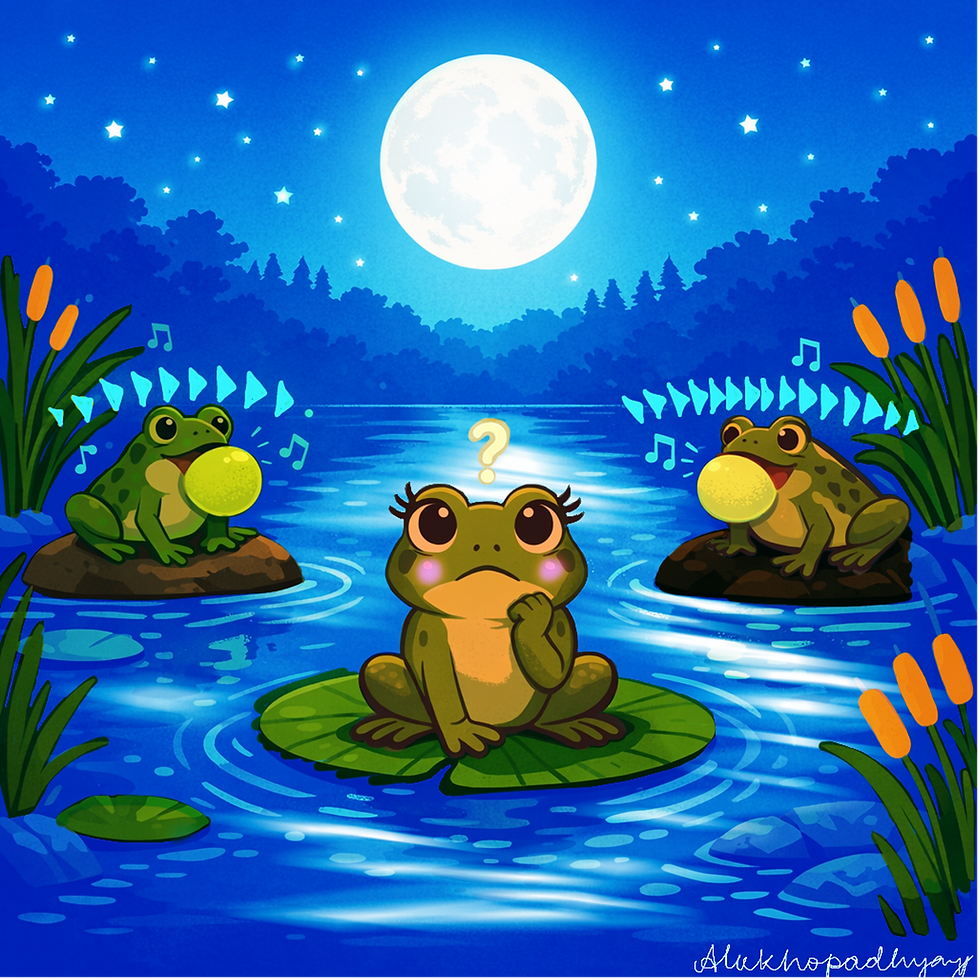
But at the pond, the party’s just getting started. These frogs, appropriately named chorus frogs (Pseudacris feriarum, if we want to be scientific), have come out to mate. They’re what biologists call explosive breeders: they only have a few nights each year to find a partner, reproduce, and pass on their genes. With such a short window, there’s no time for trial and error. Male frogs must compete with one another, each trying to out-call his neighbors and attract a female’s attention first.
But here’s the problem: another species of chorus frog, Pseudacris nigrita, has decided to gatecrash the party — and their calls sound frustratingly similar. So how does a female P. feriarum tell which male is the right one?
It’s all about rhythm
Chorus frog calls aren’t single sounds; they’re made up of repeated pulses, like a beat in a song. Volume isn’t the only thing that matters. It’s not just how loud the croak is — it’s how it’s timed. Each species has its own rhythm, its own tempo — and in the frog dating world, timing matters a lot. Some calls are slow and steady. Others are fast and frantic. P. nigrita calls, for example, have a slightly slower tempo than those of P. feriarum. To the human ear, these differences can be subtle. But to a female frog, they’re everything. Choosing the wrong call could mean mating with the wrong species, which is often a biological “dead end.” Even if mating occurs, the resulting offspring may not survive well, or they may struggle to find mates themselves.
When evolution changes the beat… and the brain
Thankfully, evolution has been busy. To avoid acoustic confusion, P. feriarum calls have changed just enough over time to stand apart from those of P. nigrita, evolving a slightly faster tempo. This process is known as reinforcement, which occurs when species living together evolve differences that help them avoid mating with the wrong species. But changing the call is only half the story — the real magic happens inside the brain. The females’ tiny brains just happen to have neural circuits tuned to specific call tempos, making them exquisitely sensitive to subtle timing differences. Over generations of sharing ponds with other chorus frog species, these neurons have evolved alongside the calls themselves. In a pond filled with dozens of overlapping calls, this neural tuning allows a female frog to filter through the noise and lock onto the rhythm of the right male, while the rest fade into the background. Here’s the kicker: because these neural preferences evolved in response to living alongside other species, the brains of these frogs have also diverged from those of chorus frogs that don’t share their ponds. In other words, the same process that helps frogs avoid the wrong mate can slowly push populations in different directions, eventually leading to the formation of new species.
But this story isn’t just about frogs; step back far enough, and this evolutionary drama becomes a story about how brains make sense of sound.
Why timing matters (even for us)
What makes this story remarkable is that the same basic problem appears across the animal kingdom, including in humans. Our brains are constantly flooded with sound, yet they somehow extract the patterns that matter most. Whether it’s understanding speech in a crowded room or locating a familiar voice, precise timing cues help our auditory system recognize sounds. Neuroscientists sometimes call this the “cocktail party effect”: our remarkable ability to focus on one voice among many others. We humans, of course, aren’t immune to rhythm either. Certain sound patterns make us tap our feet, nod our heads, or dance without thinking. There’s something in our brains that loves rhythm — and that sensitivity is built into the way we process sound. The same neural tuning that helps a frog recognize the right mate may also lay the groundwork for our love of music and movement. Frogs give us a beautifully simple window into this process, revealing how evolution shapes brains to extract meaning from timing in a noisy world.
So the next time you take an evening walk and hear a chorus of frogs erupt into what sounds like pure chaos, remember: beneath that noise is a finely tuned neural system hard at work. While we hear an overwhelming wall of croaks, a female frog hears something very different: a set of competing rhythms, each one quickly evaluated and either accepted or ignored. What sounds like noise to us is, to a frog’s brain, a high-stakes dating scene — where timing is everything.


This is soo cool!